How to Develop a Private Label Cat Litter Product
Launching a private label cat litter product involves more than selecting an existing formula and printing a logo on the bag.
For importers, distributors and pet brands, a successful product should match the target market, retail price, performance expectations, packaging strategy and supply requirements.
A structured development process can help reduce risk before mass production.
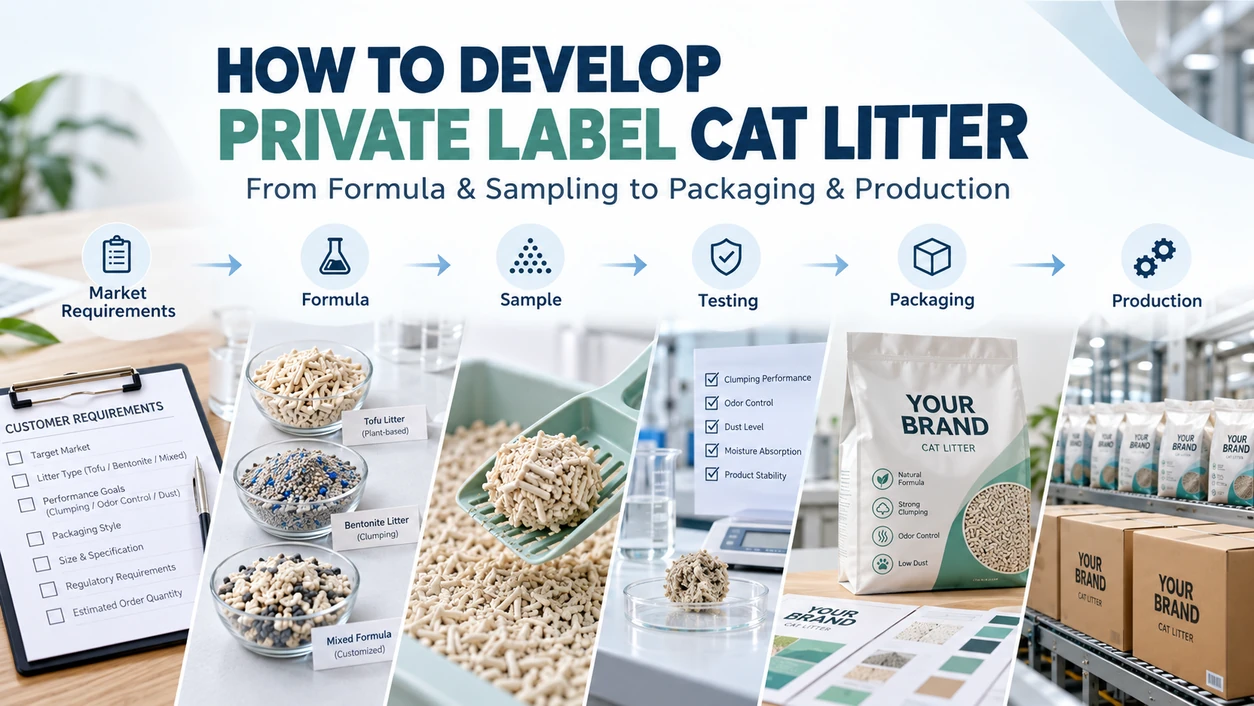
1. Define Your Target Market
The first step is to understand where and how the product will be sold.
Important factors may include:
- Target country or region
- Retail price range
- Online or offline sales channels
- Consumer preferences
- Packaging size
- Brand positioning
- Target purchase cost
A value-oriented product and a premium private label product may require very different formulas and packaging strategies.
2. Define the Product Requirements
Instead of starting only from an existing product, buyers can provide target specifications.
Common requirements include:
- Cat litter type
- Particle size
- Pellet length
- Clumping strength
- Hardness
- Dust level
- Absorption performance
- Odor control
- Fragrance
- Product color or appearance
- Target price
These requirements can be used as the starting point for formula development.
3. Develop the Formula
The formula can then be adjusted around the buyer's target performance and cost.
For tofu cat litter, this may involve changes to particle size, hardness, fragrance, clumping performance and dust level.
For mixed cat litter, additional adjustments may include blend ratio, mineral components, cassava-based materials, colored beads or other functional ingredients.
The objective is to balance:
Performance + Cost + Market Positioning
rather than simply creating the highest-cost formula.
4. Prepare Samples
After the initial formula is developed, samples can be prepared for buyer evaluation.
Buyers may evaluate:
- Particle appearance
- Clumping performance
- Dust level
- Hardness
- Fragrance
- Absorption
- Overall product feel
If the first sample does not fully match the target requirements, the formula can be adjusted and another sample can be developed.
5. Test and Compare Performance
Testing can help buyers understand whether the developed sample meets the expected product positioning.
Depending on the project, testing may include:
- Clumping comparison
- Hardness
- Dust level
- Moisture
- Absorption
- Product consistency
- Odor-control evaluation
If the buyer already has an existing product, comparison testing can also be arranged.
6. Choose the Packaging Strategy
Packaging is an important part of private label development.
Common options include:
Fully Custom Printed Bags
Suitable for established products and larger orders where the buyer wants a complete branded packaging solution.
Universal Bag + Custom Label
Suitable for trial orders, new brands and market testing where buyers want to reduce the initial packaging commitment.
Packaging can also be customized in:
- Bag size
- Net weight
- Fragrance identification
- Product information
- Barcode placement
- Transparent windows
- Carton design
- Market-specific text
7. Confirm the Final Sample and Packaging
Before mass production, buyers should confirm:
- Final formula
- Product specifications
- Sample appearance
- Packaging artwork
- Label information
- Bag size
- Carton requirements
This step helps reduce mistakes before bulk production.
8. Move to Mass Production
After the product and packaging are approved, the project can move to production.
The typical process may include:
Formula Confirmation → Packaging Confirmation → Production Planning → Quality Control → Packing → Shipment
Start With Your Requirements
You do not need to have a complete technical specification before starting.
A target market, target price, preferred product type or performance requirement can already provide a useful starting point.
Litterivo supports private label cat litter projects with:
- Custom Formula Development
- Sample Development
- Tofu and Mixed Cat Litter Solutions
- Performance Testing Support
- Custom Packaging
- Private Label Support
- Bulk Production Coordination
Tell us your target market, product positioning and price range, and we can help develop a suitable cat litter sample for evaluation.